
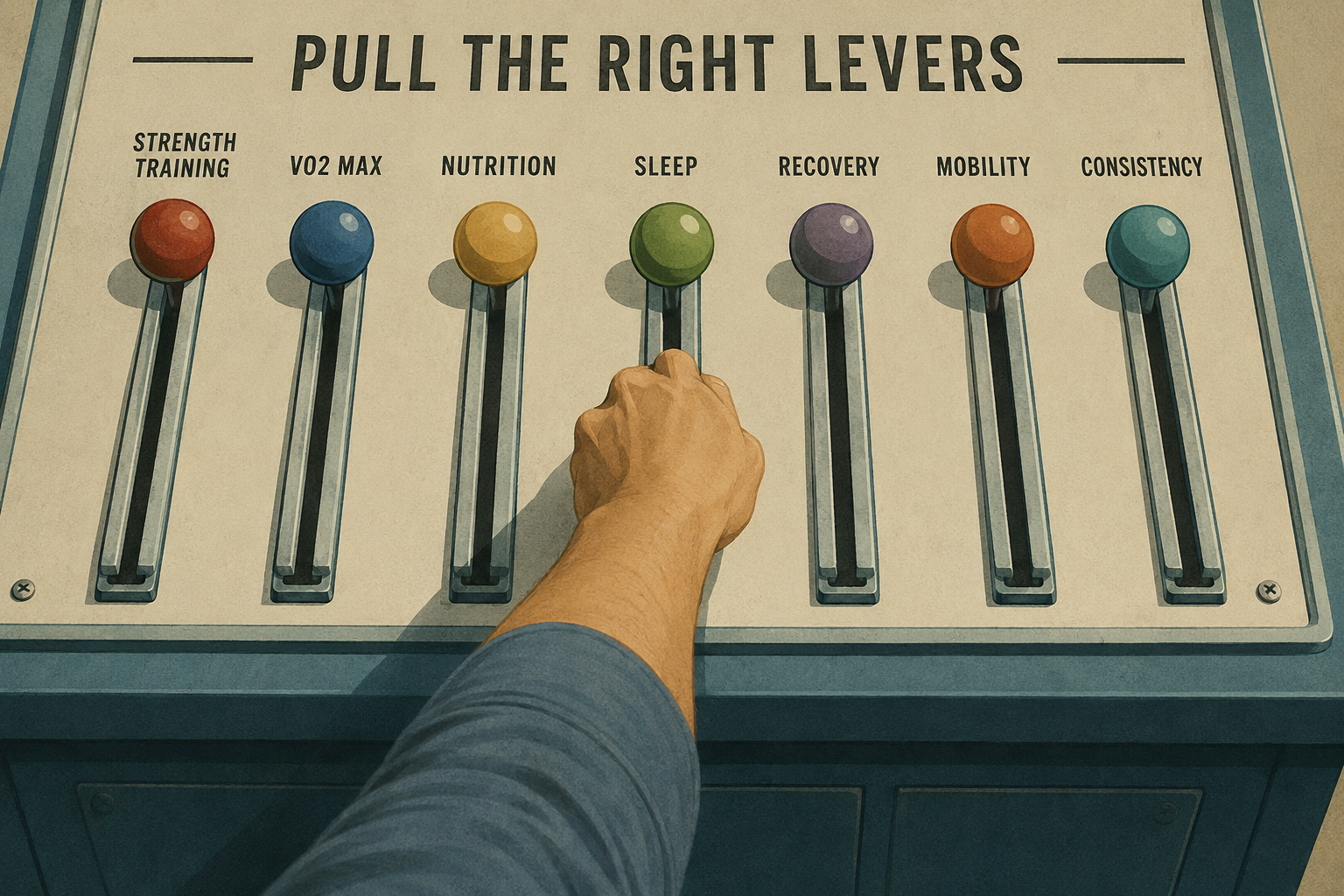
The Most Effective Levers You Can Pull to Improve Your Health
How to create the stimulus, optimize the adaptation, and keep your body prepared to handle the work.
If you want to improve your health, the most effective approach is not one magic exercise, one supplement, or one habit.
It is the strategic combination of the highest-value levers.
The most effective levers you can pull are strategic progressive resistance training, VO2 Max training, adequate protein intake, creatine supplementation, sufficient fiber intake, quality sleep, and maintaining high-quality Muscle System function.
Together, these levers support strength, muscle, cardiovascular fitness, recovery, metabolic health, mobility, pain reduction, injury risk reduction, and long-term physical function.
The most effective levers fall into three categories.
Table of Contents
- Stimulus for Adaptation A. Strategic Progressive Resistance Training B. VO2 Max
- Optimizing Adaptation Levers A. Protein Intake B. Creatine Supplementation C. Fiber D. Sleep
- Pain, Recovery, Mobility Improvement Lever Maintaining High-Quality Muscle System Function
- Conclusion
- Frequently Asked Questions
1. Stimulus for Adaptation
A. Strategic Progressive Resistance Training: The Cornerstone of Physical Health
Strategic progressive resistance training is the closest thing we have to a fountain of youth.
It is one of the most important tools for improving muscle mass, strength, endurance, and power across all age groups. It helps fight age-related decline, including sarcopenia, osteoporosis, loss of function, and loss of independence.
It also improves the body’s ability to produce force, control force, handle physical stress, and maintain mobility over time.
Metabolic and Cardiovascular Health
Resistance training improves insulin sensitivity, glucose metabolism, resting metabolic rate, and body composition. These are major factors in managing or reducing the risk of diabetes, obesity, and cardiovascular disease.
It can also help lower blood pressure and improve blood lipid profiles.
Mental Health and Quality of Life
Consistent resistance training has been shown to reduce symptoms of anxiety and depression, improve mental well-being, and enhance overall quality of life.
It can also improve pain levels, physical confidence, emotional health, and social function.
Disease Prevention and Management
Resistance training plays an important role in preventing and managing many chronic conditions, including cardiovascular disease, hypertension, chronic low back pain, and age-related physical decline.
For many people, it is not just about getting stronger.
It is about keeping the body capable.
Additional Benefits
Resistance training can also:
- Increase bone density
- Strengthen connective tissue
- Improve energy expenditure
- Support appetite regulation
- Help maintain independence and mobility
- Improve physical function with relatively minimal time investment
When done strategically and progressively, strength training (weightlifting) is the highest value health behavior available.
Learn more about personal training at Symmetry Exercise Clinic:
https://mockup2.theupsurgeagency.com/naples-personal-training/
B. VO2 Max: A Powerful Marker of Cardiorespiratory Fitness
VO2 Max is the highest rate at which the body can consume, transport, and utilize oxygen per minute.
More practically, it reflects how well the lungs, heart, blood, blood vessels, and working muscles can deliver and use oxygen when demand is high.
That matters because VO2 Max is one of the strongest measurable indicators of cardiorespiratory fitness.
Higher VO2 Max is strongly associated with:
- Better overall health
- Lower cardiovascular disease risk
- Lower all-cause mortality risk
- Lower cancer mortality risk
- Better physical resilience
- Greater ability to withstand physical stress
In simple terms, VO2 Max is not just “cardio.”
It is a marker of how well the body can deliver oxygen, produce energy, and handle demanding physical work.
The Norwegian 4×4 is an excellent and highly recommended method for increasing VO2 Max:
https://vimeo.com/75764170?fl=pl&fe=sh
2. Optimizing Adaptation Levers
A. Protein Intake: Fuel for Muscle Growth and Recovery
Adequate protein intake gives the body the raw material it needs to adapt to strategic progressive resistance training.
Resistance training creates the stimulus.
Protein helps provide the building blocks.
Without enough protein, the body’s ability to build and maintain muscle is limited. This becomes even more important with age, during weight loss, after injury, after surgery, or during any period where preserving muscle matters.
Protein supports:
- Muscle repair
- Muscle growth
- Recovery from training
- Strength development
- Maintenance of lean tissue
- Healthy aging
Resistance training and protein work together.
One provides the signal.
The other helps supply the materials.
B. Creatine Supplementation: Amplifying Training Outcomes
Creatine is one of the most researched and useful supplements available.
It can help enhance strength, power, training performance, and recovery from strategic progressive resistance training. It may also support brain health, bone health, and mental health.
Creatine does not replace training.
It helps improve the body’s ability to benefit from training.
The general recommended dose is 5 g of creatine monohydrate per day, although research is emerging showing greater than 5 might be beneficial for brain health.
For more on creatine, read this:
https://mockup2.theupsurgeagency.com/creatine/
C. Fiber: The Incredible Health-Impacting Nutrient
Fiber is not glamorous, but it is extremely important.
Higher fiber intake is consistently associated with better health outcomes. The evidence is strongest for cardiovascular health, digestive health, metabolic health, and overall disease-risk reduction.
Major Benefits of Fiber
Higher fiber intake is associated with:
- Lower risk of cardiovascular disease mortality
- Lower risk of coronary heart disease
- Lower risk of all-cause mortality
- Lower risk of diverticular disease
- Improved gastrointestinal function
- Better blood sugar regulation
- Better cholesterol profiles
- Improved satiety and appetite regulation
Some research also suggests associations between higher fiber intake and lower risk of certain cancers.
Not every fiber-related claim has the same level of evidence, but the overall case is strong:
Most adults would likely benefit from eating more fiber.
Practical Fiber Target
A practical general target is:
About 30 grams of fiber per day for most adults.
A useful range:
- Women: approximately 26–28 grams per day
- Men: approximately 32–35 grams per day
You do not need to obsess over exact numbers. But if you are eating very little fiber, moving toward 30 grams per day is a meaningful step.
D. Sleep: The Recovery Foundation
Sleep is where much of the recovery process happens. In other words, sleep is where the body greatly adapts to the stimulus of strategic progressive resistance training and VO2 Max training.
Poor sleep can interfere with:
- Muscle recovery
- Strength gains
- Hormonal regulation
- Appetite regulation
- Mood
- Energy
- Pain sensitivity
- Mental performance
- Immune function
Chronic sleep restriction undermines many of the benefits people are trying to get from exercise, nutrition, and supplementation.
Training matters.
But if sleep is consistently poor, the body’s ability to recover and adapt is compromised.
3. Pain, Recovery, Mobility Improvement Lever
Maintaining High-Quality Muscle System Function
Resistance training and VO2 Max training are powerful health levers, but they only matter if your body can participate in them consistently.
That is where maintaining high-quality Muscle System function becomes important.
If pain, tightness, stiffness, injury, surgery, or mobility limitations are preventing you from starting strategic progressive resistance training or cardiovascular work, or if those issues show up while you are already training, the Muscle System Specialist process becomes a lever you can pull.
The Muscle System Specialist methodology is a uniquely capable way of addressing pain and mobility issues by assessing how well your Muscle System is controlling your body under specific conditions.
The goal is not simply to chase the painful area.
The goal is to identify and improve control throughout your Muscle System to reduce pain, improve mobility, and help you to be able to continue pulling the resistance training and cardiovascular training levers consistently.
Periodic Muscle System check-ups can help identify areas of poor control before they become larger problems, making it a strategic tool for reducing injury risk and helping your body stay prepared to handle the work.
Learn more about the Muscle System Specialist process:
https://mockup2.theupsurgeagency.com/muscle-system-specialist/
Conclusion
The most effective strategy for improving health, Muscle System quality, physical performance, and long-term function is to combine:
- Strategic progressive resistance training
- VO2 Max/cardiorespiratory fitness training
- Adequate protein intake
- Creatine supplementation
- Sufficient fiber intake
- Quality sleep
- Maintaining high-quality Muscle System function
At Symmetry Exercise Clinic in Naples, Florida, we help people improve strength, mobility, Muscle System function, and long-term physical health through strategic progressive resistance training and the Muscle System Specialist process.
If pain, mobility limitations, previous injury, surgery, or uncertainty about your body is stopping you from exercising consistently, the first step is not guessing.
The first step is finding out what your Muscle System can and cannot control.
The goal is not to chase every possible health tactic. The goal is to consistently pull the biggest levers that create adaptation, support recovery, and keep your body capable.
Need help?
https://mockup2.theupsurgeagency.com/contact/
Check out our 5-star Google reviews:
https://mockup2.theupsurgeagency.com/reviews/
Frequently Asked Questions
What are the most effective levers for improving health?
The most effective levers for improving health are strategic progressive resistance training, VO2 Max training, adequate protein intake, creatine supplementation, sufficient fiber intake, quality sleep, and maintaining high-quality Muscle System function.
What is the highest value health behavior available?
When done strategically and progressively, strength training, or weightlifting, is the highest value health behavior available.
It supports muscle, strength, bone density, metabolism, mobility, independence, and long-term physical function.
Why is resistance training so important for health?
Resistance training helps preserve and build muscle, improve strength, support bone density, improve glucose metabolism, reduce age-related decline, and maintain physical independence.
It is not only about looking better.
It is about keeping the body capable.
Why does VO2 Max matter?
VO2 Max matters because it reflects how well the body can consume, transport, and utilize oxygen per minute.
Higher VO2 Max is strongly associated with better cardiorespiratory fitness, better physical resilience, and lower risk of several major health problems.
What is the Norwegian 4×4 method?
The Norwegian 4×4 is an interval training method commonly used to improve VO2 Max. It generally involves four hard intervals, each lasting four minutes, with recovery periods between intervals.
The Norwegian 4×4 is an excellent and highly recommended method for increasing VO2 Max:
https://vimeo.com/75764170?fl=pl&fe=sh
Why does protein matter for strength training?
Protein provides the raw material the body needs to repair, build, and maintain muscle tissue.
Resistance training creates the stimulus.
Protein helps provide the materials needed to adapt to that stimulus.
How much creatine should most adults take?
The general recommended dose is 5 g of creatine monohydrate per day, although research is emerging showing greater than 5 might be beneficial for brain health.
For more on creatine, read this:
https://mockup2.theupsurgeagency.com/creatine/
How much fiber should adults eat per day?
A practical general target is about 30 grams of fiber per day for most adults.
A useful range is approximately 26–28 grams per day for women and approximately 32–35 grams per day for men.
Why does sleep matter for training adaptation?
Sleep is where much of the recovery process happens.
If sleep is consistently poor, the body’s ability to recover from and adapt to resistance training, VO2 Max training, and other health behaviors is compromised.
What should I do if pain or mobility problems keep me from exercising?
If pain, tightness, stiffness, injury, surgery, or mobility limitations are stopping you from exercising consistently, the Muscle System Specialist process can help assess how well your Muscle System is controlling your body under specific conditions.
The goal is to improve control throughout your Muscle System, reduce pain, improve mobility, and help you continue pulling the resistance training and cardiovascular training levers consistently.